Short answer
Prepackaged food sold in the UAE follows UAE.S GSO 9, the UAE's adoption of the GCC labelling standard. The label must be in Arabic, with any other language saying the same thing. It needs the product name, ingredients in descending order, allergens, net quantity in metric units, both production and expiry dates, storage conditions, country of origin, the maker's or packer's name and address, a lot number, and a nutrition panel. Dates must be printed indelibly on the label or pack itself, not on a sticker. Labels are assessed before sale, so get yours approved before printing a big run.
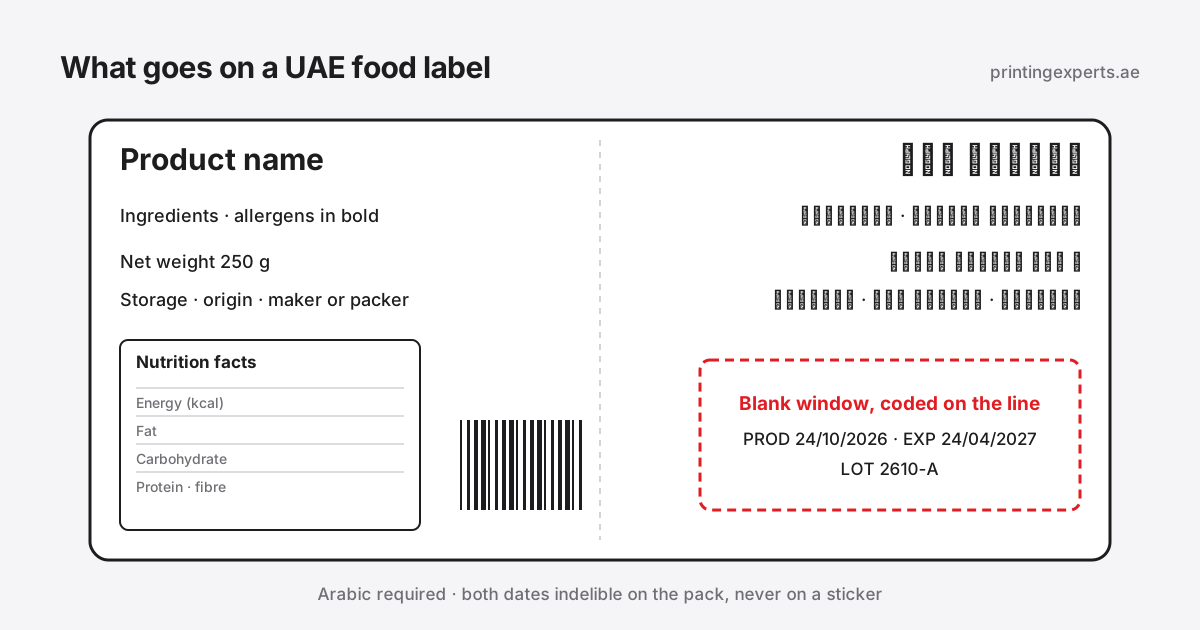
This guide is for bakeries, cloud kitchens, small food producers and importers. It sets out what UAE food labels must show, in plain words, and then the practical side: materials, print methods and how to leave room for dates. It's a summary of public guidance, not legal advice. Your food authority's label assessment has the final say.
The rules in one place
Labelling of prepackaged food in the UAE follows UAE.S GSO 9, the UAE adoption of the GCC standard "Labeling of prepackaged food stuffs". The US Department of Agriculture's November 2025 report on UAE food import rules cites the 2019 UAE edition. The GCC has since issued a 2022 edition and a 2025 amendment, so ask your authority which edition applies to your product.
According to that report, a UAE food label must carry:
| Particular | What it means in practice |
|---|---|
| Product name | Shown prominently; describes the food truthfully |
| Ingredients | In descending order of weight; additives by class name (e.g. "emulsifier"); the animal source of animal-derived ingredients such as gelatin |
| Allergens | Declared clearly. The standard's list includes cereals containing gluten, crustaceans, eggs, fish, peanuts, soy, milk, tree nuts, sesame and sulphites at 10 ppm or more. Check the current list with your authority |
| Net quantity | Metric: volume for liquids, weight for solids; drained weight for food in liquid |
| Production and expiry dates | Both, printed indelibly (see below) |
| Storage conditions | Where they affect the date, e.g. "keep refrigerated at 0–4 °C" |
| Country of origin | Where the food was made |
| Name and address | Of the manufacturer, or the packer if different |
| Lot or batch number | Coded or plain, indelible |
| Nutrition declaration | Mandatory under UAE.S GSO 2233: energy (kcal), carbohydrate, fat, protein and fibre, plus any added vitamins and minerals |
| Instructions and warnings | Instructions for use where needed; mandatory warnings, such as the warning required with certain colours |
| Arabic | Required; any other language must say exactly the same |
Arabic, and when a sticker is allowed
The label must be in Arabic. You can add English or another language, as long as it says the same thing. Imported products whose original label lacks Arabic can carry one Arabic sticker, but only if it hides none of the required information, doesn't contradict the original, can't be removed in normal handling, and is approved in the label assessment. For imports, the sticker should be applied before export, not on arrival. Products for hotels and catering can enter without Arabic, but can't be sold in retail without an Arabic label.
Dates: the rule that changes how you print
- Both dates. Production and expiry dates are both required. "Best before" or "use by" wording is allowed for the expiry, but doesn't replace the production date.
- Indelible, on the pack. Dates must be printed, embossed, engraved or stamped in indelible ink on the original label or the primary pack. Dates only on a sticker aren't accepted, and only one set of dates is allowed.
- Format. For shelf life of three months or less: day/month/year. Over three months: day/month/year or month/year (then the last day of the month is the expiry).
- Exceptions. A few foods need only a production date, including bakery products eaten within 24 hours of making, honey, spices and loose tea.
- Never re-date. Tampering with dates is treated as a major violation.
The practical consequence: don't pre-print dates on your labels. Print the label with a clear window, and add the dates and lot number on your line with a date coder (a thermal transfer overprinter on the label or film, or an inkjet coder on the pack). Tell your label printer the coder you use, so the window, the material and the varnish suit it.
Nutrition panels, traffic lights and Nutri-Mark
The nutrition table under UAE.S GSO 2233 is mandatory. Colour-coded front-of-pack schemes aren't, yet: the UAE Cabinet made the red-amber-green traffic-light label (UAE.S 5034) voluntary in December 2021, and Abu Dhabi's A-to-E Nutri-Mark grade was still voluntary in mid-2026, with thousands of products registered and talk of a federal requirement. Leave space on the front of pack in case either becomes mandatory for your category.
Label assessment before you sell
UAE authorities assess food labels before products are sold or imported, through the federal ZAD portal or emirate systems such as Dubai Municipality's. Each pack size counts as a separate item, and any later change to the label needs a fresh assessment. Dubai Municipality has asked local factories to request a label evaluation for every new product. Claims such as halal, "GMO-free", health or nutrition claims need supporting certificates; the UAE national halal logo is voluntary, but other halal marks aren't allowed.
So the order of work is: draft the label, get it assessed, then print the production run. Print a short digital run for the assessment and launch, and move to a long run once the label is final.
Choosing the label itself
| Your product | Label material | Adhesive | Finish |
|---|---|---|---|
| Dry goods, boxes, jars at room temperature | Paper | Permanent | Varnish |
| Chilled, wet or oily (dairy, sauces, dips) | BOPP (polypropylene film) | Permanent, moisture-resistant | Laminate for oil and condensation |
| Frozen | BOPP or PE film | Freezer-grade, applied cold if needed | Laminate |
| Squeezable bottles, curved or tapered packs | PE (conformable film) | Permanent | Flexible varnish or laminate |
| Glass bottles | Paper or clear film; watch the mould seams | Permanent; ice-bucket resistant if chilled | Varnish or laminate |
Standard adhesives lose grip in the cold, so tell the printer whether labels are applied to cold or frozen packs, not just stored that way. Ink and label must never transfer onto the food.
Digital or flexo?
Digital label printing has almost no set-up cost, so it suits short runs, launches, seasonal flavours and many SKUs, as well as the label assessment stage. Flexographic printing needs plates and dies for each design, but is cheaper per label on long runs of a few designs. The crossover depends on your quotes: ask for both at your real quantities per SKU.
Before you send artwork to the printer
- All mandatory particulars present, in Arabic and any other language, saying the same
- Allergens clearly emphasised in the ingredients
- Nutrition table in the required format, energy in kcal
- A blank window for production date, expiry date and lot number, sized for your coder
- Net quantity in metric units
- Barcode tested at the printed size
- Label size checked on the actual container, including curves and seams
- Label assessment approved for this exact artwork and pack size
- Material, adhesive and finish chosen for storage and how the label is applied
Where to get labels made in the UAE
Large converters such as CCL Label in Dubai, Fortune Pack Labels and Emirates Printing Press produce pressure-sensitive labels and sleeves at volume. Veesham Printing Press in Al Quoz prints labels and stickers for smaller runs. Our print services advisor points you to the right one for your quantity. Boxes too? See getting custom boxes made.
Questions buyers ask
Can my label be in English only?
Not for retail sale. Arabic is required; English can sit alongside it.
Can I put the dates on a sticker?
No. Dates must be indelible on the original label or pack. A sticker is allowed only for an Arabic translation, under strict conditions.
Do I need the traffic-light label?
It's voluntary in the UAE as of 2026, as is Abu Dhabi's Nutri-Mark. The standard nutrition table is mandatory.
I sell fresh bread daily. Do I need an expiry date?
Bakery products meant to be eaten within 24 hours are among the foods that need only a production date. Confirm with your authority for your product.
Sources
- USDA FAS: UAE food and agricultural import regulations and standards (FAIRS), November 2025
- GSO: GSO 9:2022 Labeling of prepackaged food stuffs
- US International Trade Administration: UAE labelling and marking requirements
- Khaleej Times: UAE Cabinet amends food labelling policy (traffic lights voluntary)
- Aletihad: Nutri-Mark update, August 2026
- Gulf News: Dubai Municipality re-evaluates local food labels
- Avery Dennison: how to choose the right film facestock