Short answer
Start from the rules and the laundry, then the look. Dubai's Food Code expects food handlers to wear clean, preferably light-coloured clothing, with hair covered, and to have at least four sets of uniforms each. Pick cotton-rich fabric for comfort in the heat, or poly-cotton for easy care, and embroider logos on heavier fabrics. Ask for wash ratings that match commercial laundering, run a wear trial, and choose a range the supplier can still supply when you reorder.
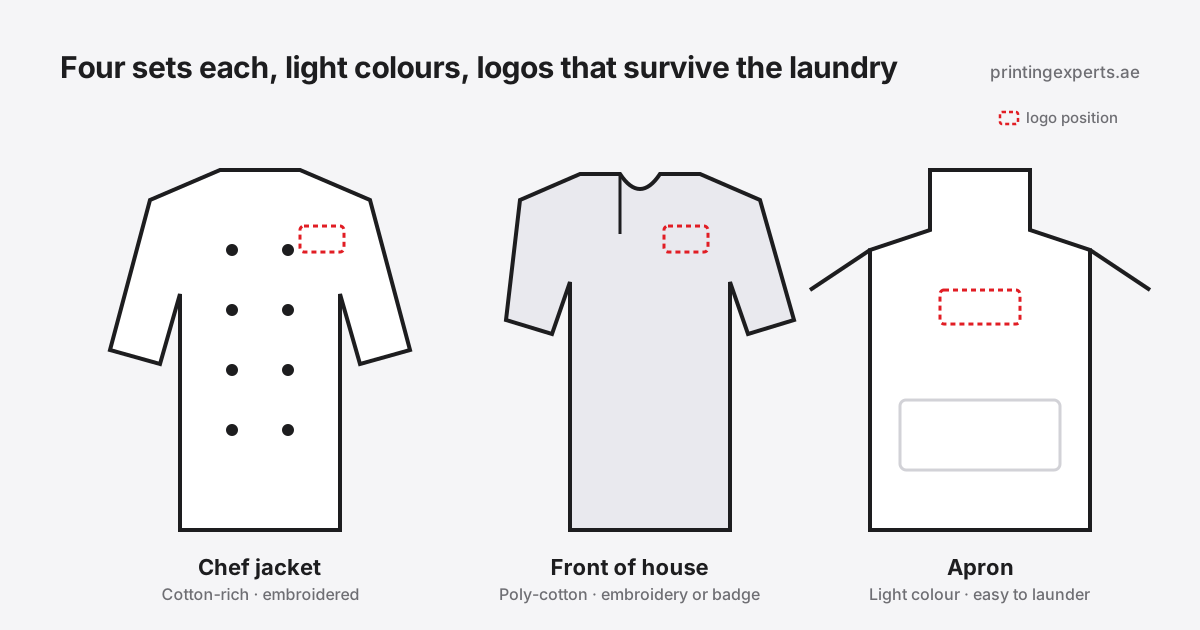
Uniform buying in hospitality is usually rushed: an opening date, a new brand, a supplier who promises everything in three weeks. The problems show up later: logos that crack after a month in an industrial laundry, a reorder that doesn't match, chefs who hate the jacket. This guide covers the decisions that prevent them.
Start with the food-safety rules
If staff handle food in Dubai, the Dubai Municipality Food Code sets expectations for what they wear. In the 2013 Food Code, still published by Dubai Municipality, food handlers should:
- Wear only clean, preferably light-coloured outer clothing or protective overalls
- Have at least four sets of uniforms each
- Cover their hair with a clean hat or hairnet, and beards with beard nets where required
- Not wear watches or jewellery that can come off easily
- Preferably avoid buttons, for those who directly handle food
- Wash protective clothing at least once a day, or when it becomes soiled
Other emirates enforce similar rules. In Abu Dhabi, inspectors have closed food outlets for failing to wear protective clothing, such as head covers and gloves, in preparation areas. Check the current requirements with your food authority. For buying, the practical upshot is: budget for four or more sets per kitchen staff member, choose colours that show cleanliness, and choose fastenings carefully for anyone who touches food.
Fabric for the UAE heat
| Fabric | Strengths | Weaknesses | Good for |
|---|---|---|---|
| 100% cotton | Absorbent and breathable; comfortable when sweating | Wrinkles, can shrink unless pre-shrunk | Chef jackets, kitchen staff |
| Poly-cotton (e.g. 65/35) | Easy care, durable, holds colour, little ironing | Less comfortable than cotton when hot and sweaty | Front-of-house shirts, housekeeping, aprons |
| Moisture-wicking polyester | Moves sweat along the fabric, dries fast, light | Doesn't absorb; can feel clammy and pill where rubbed | Delivery riders, outdoor and events staff |
A shirt generally needs at least 50–65% polyester to need little or no ironing; more cotton means more comfort. In wear trials run by Cotton Incorporated, an industry body, men sweating in warm, humid conditions preferred 100% cotton shirts over polyester-rich blends. When there was little sweating, they felt about the same. So match the fabric to the job: kitchen and outdoor staff sweat; reception staff in air conditioning mostly don't.
Near open flames, consider cotton-rich fabrics. Synthetics can melt when exposed to high heat. Whether you need certified flame-resistant clothing is a question for your safety assessment, not a default.
How to put the logo on
| Method | Looks | Best on | Ask about |
|---|---|---|---|
| Embroidery | Premium, textured, long-lasting | Chef jackets, polos, caps, aprons | Priced by stitch count, with a one-off digitising fee; dense designs pucker on thin stretch fabric (use a patch) |
| Woven badge or patch | Neat, uniform-like | Light or stretchy fabrics, outerwear | Sewn or heat-applied; sewn lasts longer |
| Screen printing | Flat, solid colours | T-shirts, large runs | Set-up per colour; wash durability of the ink |
| Heat transfer / DTF | Full colour, sharp detail | Short runs, names, many designs | The transfer's rating for industrial laundering, not domestic washing |
| Sublimation | Colour dyed into the fabric, no feel | White or light polyester only | Not suited to cotton or dark garments |
Keep names and job titles flexible: a separate name badge or a small heat-applied name lets staff change without remaking the garment.
Laundering: the test most buyers skip
Hotel and restaurant uniforms are often washed hot and commercially, much harder than a home wash. Two standards are worth knowing when you ask a supplier for test results:
- ISO 105-C06 tests colourfastness to domestic and commercial laundering, but its own scope notes that industrial and hospital laundering may be more severe. A pass doesn't prove the fabric survives an industrial laundry.
- ISO 15797 sets test procedures for workwear that is industrially laundered: shrinkage, colour, creasing, seam puckering and pilling across repeated cycles.
Ask for results for both the fabric and the logo method. Better still, send a few finished uniforms through your actual laundry, five to ten cycles, before you sign off the full order.
Run a wear trial
Ask the supplier for sample garments in a full size range, and have staff in each role wear them for real shifts. Check comfort in the heat, pockets and fit for the job (a server reaches and bends, a chef needs sleeve room), and how the garment looks after a few washes. Use the trial to fix the size split for the order, so you're not left with boxes of the wrong sizes.
Plan for the reorder
You'll reorder for new staff and replacements for years, so think about it before the first order:
- Stock or custom? Catalogue ranges have no minimum and ship quickly, but can be discontinued. Ask how long the supplier guarantees the range. Custom designs take longer and need a minimum order, but you control the supply.
- Dye lots: colour can vary between batches of fabric. Ask the supplier to record the lot or shade number, and approve a sample from each new batch against the original.
- Spares: keep a small buffer stock of common sizes so new staff can start in uniform.
A brief you can send to uniform suppliers
- Roles and quantities
- e.g. 12 kitchen (chef jacket, trousers, apron, cap), 20 front of house (shirt, apron), 6 housekeeping. Sets per person (four or more for food handlers)
- Fabric
- Preferred composition by role, colour (light for food handlers), weight
- Branding
- Logo file (vector), method by garment (e.g. embroidery on jackets), position and size, name badges
- Laundering
- Commercial or in-house, wash temperature; ask for ISO 105-C06 and ISO 15797 results or a wash trial
- Sizes
- Wear trial first; then the size split by role
- Supply
- Stock or custom; range availability for reorders; dye-lot control; buffer stock
- Dates
- Trial date, approval date, delivery date for opening or launch
Where to source in the UAE
Dubai has uniform makers with their own cutting, stitching and embroidery, such as Comfort Uniforms in Abu Hail, alongside catalogue suppliers and embroidery shops that brand garments you supply. Teamwear and sportswear makers, such as IPU Sports, suit staff in performance fabrics. Our source advisor lists them by trade.
Questions buyers ask
How many uniforms per employee?
For food handlers in Dubai, the Food Code says at least four sets. For other roles, count wash cycles: how many shifts a week, and how fast the laundry turns uniforms around.
Do kitchen uniforms have to be white?
The Dubai Food Code says preferably light-coloured, not white. Light colours show soiling, which is the point.
Embroidery or print for a restaurant?
Embroidery for jackets, polos, aprons and caps that are washed often. Print or heat transfer for T-shirts, short runs and anything that needs full colour, as long as it's rated for your laundry.
How long does a uniform order take?
Catalogue garments with embroidery can be quick; custom designs need sampling, a wear trial and production. Plan backwards from your opening date and leave room for one round of changes.
Sources
- Dubai Municipality: Food Code (2013), personal hygiene and protective clothing
- Gulf News: Abu Dhabi closes food outlets over hygiene violations
- ISO 15797: industrial washing and finishing of workwear
- BSI: ISO 105-C06 colour fastness to laundering
- Cotton Incorporated: the measurement of cotton's comfort
- Wilcom: how embroidery is priced