Short answer
Pure Beverages Industry Company (PBIC), the Saudi producer of Oska and Ival water, prints its glass bottles directly, with no label, on two LSINC cylindrical UV printers bought from PRO TECHnology: a PeriOne first, then a PeriQ360 for capacity. According to PRO TECHnology, PBIC runs them two to three shifts a day for Saudi National Day and Ramadan editions and co-branded bottles for hotel customers. Almarai acquired PBIC in 2025 for SAR 1.04 billion.
The company
Pure Beverages Industry Company (شركة المشروبات النقية للصناعة), known as PBIC, produces bottled water in Saudi Arabia under two brands: Oska (أوسكا), with added calcium, magnesium and potassium, and Ival (إيفال). Its plants are at Al-Kharj, south of Riyadh (opened 2021), and Jeddah (opened 2022). The Jeddah plant includes a glass bottle line for premium hotel and catering customers, and Oska is sold in 750 ml glass bottles as well as PET.
The problem: glass bottles that look like everyone else's
In hotels and restaurants, a glass water bottle sits on the table in front of every guest. Most are decorated with a label, and changing a label means new artwork, new plates and a new print run from a label converter. That makes short editions (a national day, a season, a single hotel's logo) slow and expensive. PBIC wanted its glass bottles to stand out with hospitality customers, and to change designs as often as its customers and campaigns needed.
The solution: two LSINC printers, bought one at a time
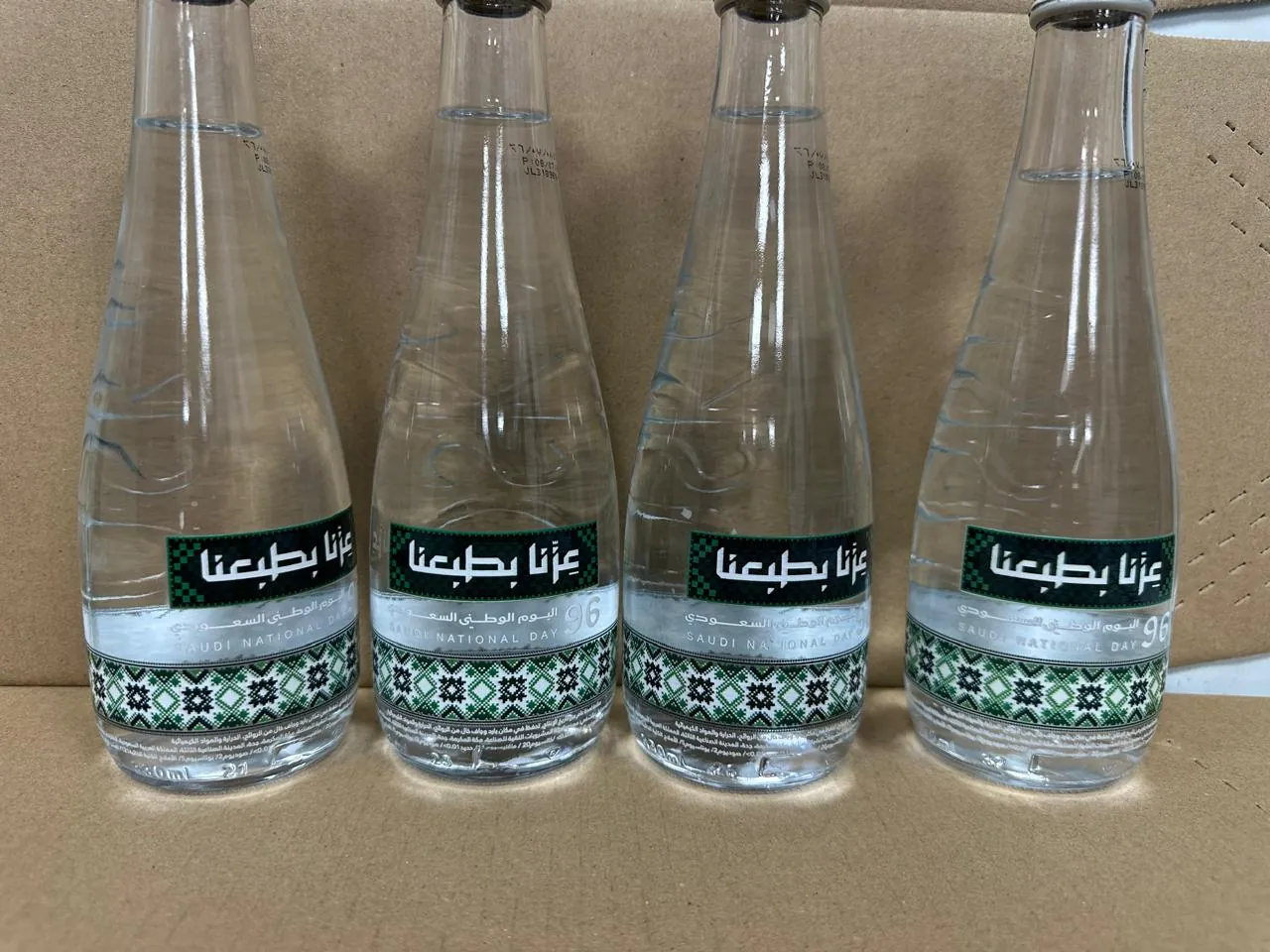
On PRO TECHnology's recommendation, PBIC started with an LSINC PeriOne, a hand-loaded 360° printer for samples and short runs, and later added a PeriQ360, which prints four bottles per cycle with semi-automatic loading, for production capacity. Both are designed and built by LSINC in Huntsville, Alabama, and both print the design straight onto the glass in UV-cured CMYK and white ink, all the way around the bottle, alongside the existing filling line. There's no label, sleeve or adhesive.
According to PRO TECHnology, which supplied, installed and supports the machines, PBIC runs them two to three shifts a day: real industrial production, not a sampling room.
What PBIC prints
- Oska glass bottles printed directly, including sparkling water designs
- Saudi National Day editions (23 September), like the bottles above
- Ramadan campaign designs
- Co-branded bottles for hotels: the hotel's name or logo printed on the bottle alongside the water brand. According to PRO TECHnology, offering co-branding helped PBIC win hotel chain accounts.
Because nothing has to be made for each design (no plates, screens or label stock), a new hotel, a new campaign or a new occasion is a new file and a test print. Founding Day (22 February) is another occasion Saudi brands now personalise for.
What happened next
On 15 June 2025, Almarai announced an agreement to acquire 100% of Pure Beverages Industry Company for SAR 1.04 billion, which it completed on 31 July 2025. Almarai said the deal was in line with its plan to diversify its beverage offerings; at the time, PBIC held about 8.6% of the Saudi bottled water market by volume, according to Almarai's annual report. PBIC's Oska and Ival brands now sit within Almarai's water business.
Lessons for other bottlers and brands
| Question | What PBIC's case suggests |
|---|---|
| When does in-house printing pay? | When designs change often: co-branded customers, seasons, campaigns. Keep labels for the high-volume, unchanging SKUs. |
| Which machine first? | A hand-loaded PeriOne to prove the market and the process, then a PeriQ360 once demand needs capacity. |
| Who is the customer? | Hotels and restaurants value a bottle with their own name on the table; in Saudi searches, water for the HoReCa channel (قناة الهوريكا) is a recognised category. |
| What makes it work in production? | Trained operators, local service and consumables, and running the printer in shifts beside the filling line. |
Thinking of doing the same?
- Test your bottle. Run trials on your own glass or PET at Sun Studio's cylindrical printing studio in Al Quoz, on a PeriOne or PeriQ360, and test adhesion, chilling and handling.
- Count the designs, not just the bottles. List how many co-brands, seasons and campaigns you'd run in a year.
- Model the payback on your own volumes, prices and labour, with your distributor.
- Plan the line: where the printer sits, who loads it, and how many shifts.
For machine choice, read our explainer on cylindrical printing and the PeriQ360, PRO TECHnology's guide for beverage manufacturers, and its own PBIC case study.
Sources
- Argaam: Almarai to acquire Pure Beverages Industry Co. for SAR 1.04 billion
- Arab News: Almarai to acquire Pure Beverages Industry Co.
- Almarai annual report: emerging businesses (Oska and Ival)
- Enterprise: Almarai finalises takeover of Pure Beverages
- PETplanet: Pure Beverages plants in Al-Kharj and Jeddah
- PRO TECHnology: PBIC and LSINC Peri series case study
- LSINC: PeriQ360