Short answer
Order a bag built for reuse, not a thin carrier. Thin paper and plastic bags are banned in Dubai (under 57 micrometres), and federally, single-use bags of any material under 50 microns have been banned since 1 January 2026. Choose kraft paper with twisted handles for everyday retail, laminated art paper for luxury, non-woven polypropylene for low-cost promotional totes, and cotton canvas for bags people keep. Get the material thickness and weight in writing.
If you run a shop, café or brand in the UAE, the bag you hand customers is now regulated. The rules differ by emirate and have tightened in stages, so many supplier pages are out of date. This guide sets out the current position, then the buying decisions: material, weight, handles, print method and quantity.
What the rules say
| Where | Rule | From |
|---|---|---|
| Whole UAE (federal) | Single-use plastic shopping bags banned, including biodegradable plastic (Ministerial Resolution No. 380 of 2022) | 1 January 2024 |
| Whole UAE (federal) | Single-use bags of any material, including paper, thinner than 50 microns banned, along with single-use plastic cups, lids, cutlery, plates, straws, stirrers and Styrofoam food containers | 1 January 2026 |
| Dubai | Single-use bags (plastic, paper or plant fibre thinner than 57 micrometres) banned in stages: plastic first, then paper and other materials (Executive Council Resolution No. 124 of 2023) | 1 January 2024 (plastic), 1 June 2024 (paper and others) |
| Abu Dhabi | Single-use plastic shopping bags banned | 1 June 2022 |
| Sharjah | Trading, producing or importing single-use plastic bags banned | 1 January 2024 |
Three things follow for a retailer:
- Paper isn't automatically allowed. A thin paper carrier counts as single-use in Dubai and, below 50 microns, federally. A sturdy, reusable paper bag is fine.
- You can charge for reusable bags. Dubai's resolution requires vendors to offer reusable alternatives at reasonable prices. The old 25-fils charge on thin bags ended when those bags were banned.
- There are exemptions, such as thin rolls for meat, fish, fruit, vegetables and bread, and rubbish bags. They don't cover a branded shopping bag.
The thresholds are given as thickness, but bag makers usually quote weight (gsm). Ask your supplier to state in writing the thickness of the finished bag material in micrometres and confirm that it complies with the rules where you trade. Rules change, so check with your emirate's municipality if you're unsure.
Paper, non-woven or cotton?
| Material | Feels like | Best for | Typical spec | Usual print method |
|---|---|---|---|---|
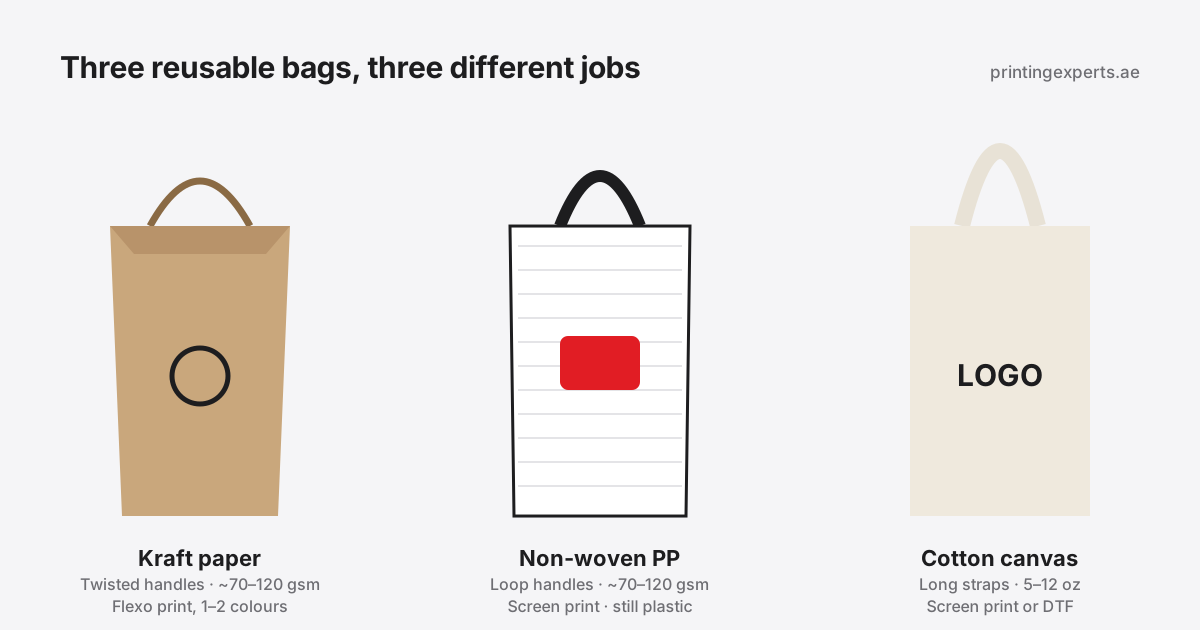
| Kraft paper (brown or white) | Natural, everyday retail | Fashion, pharmacy, bakeries, takeaway | About 70–120 gsm; flat handles on lighter bags, twisted paper handles on heavier ones | Flexo for long runs; 1–2 colours look best |
| Laminated art paper | Smooth, rigid, luxury | Perfume, jewellery, gifting, premium retail | Heavier coated board, matt or gloss lamination, rope or ribbon handles | Offset with foil, embossing or spot UV |
| Non-woven polypropylene | Light fabric-like plastic | Promotional totes, events, supermarkets | Bags typically 70–120 gsm; cheaper promotional bags 60–70 gsm | Screen printing, usually 1–2 solid colours |
| Cotton or canvas | Soft, durable, kept for years | Merchandise, conferences, brand totes | 5 oz (about 170 gsm) for light totes; 10–12 oz (about 340–400 gsm) for sturdy canvas | Screen printing; DTF for full colour in short runs |
Non-woven polypropylene is still plastic, so don't market it as plastic-free. It's popular because it's cheap and strong for its weight, but the UAE rules don't name it directly. Choose a weight clearly designed for repeated use and keep the supplier's thickness statement on file.
Which is greener? It depends on reuse
The honest answer is that a reusable bag only beats a thin plastic carrier if it's reused enough times. Two government life-cycle studies give a sense of scale:
| Bag | UK Environment Agency (2011): reuses to match a thin plastic bag on climate impact | Danish EPA (2018): reuses to match a plastic bag on climate impact |
|---|---|---|
| Paper | 3 | 0–1 |
| Non-woven polypropylene | 11 | 6 |
| Cotton | 131 | 52 (conventional) · 149 (organic) |
The studies used different reference bags and assumptions, and both looked at European supermarket bags. The Danish study found much higher numbers when all environmental indicators were counted, not just climate. The practical lesson: a cotton bag is worth it only if people keep and use it, so make it something they'll want to carry. For a bag handed out with every purchase, a well-made paper or non-woven bag is usually the better fit.
Getting the specification right
- Size and gusset to fit your largest product, measured with the product in hand.
- Load: how heavy the bag must carry. Tell the supplier, and ask what handle and paper weight they recommend for it.
- Handles: flat paper (light loads), twisted paper (everyday), rope or ribbon (luxury), loop or die-cut (non-woven), long straps (cotton totes).
- Base and top fold: a card base insert and a reinforced top help paper bags hold their shape.
- Printing: number of colours, one or both sides, full bleed or a logo, Pantone references.
- Finish: lamination, foil, embossing or spot UV (art paper only).
- Certification: if you'll make an environmental claim, ask for FSC-certified paper and check the certificate on FSC's public database.
- Compliance statement: material thickness in micrometres, in writing.
Quantities, sampling and lead times
Printed bags carry set-up for each design: printing plates or screens, and for paper, often a bag-making machine set to your size. That's why the price per bag drops steeply as quantity rises. Ask for prices at two or three quantities, and choose a standard size from the supplier's range if you need a small first run. Always approve a pre-production sample with your print on it before the full run; check colour, handle strength and how the bag stands.
Where to source in the UAE
Large converters make paper bags on automatic lines: Hotpack makes kraft paper bags printed on flexo in its own Dubai plants, and Shabouk Printing & Packaging makes premium paper bags for perfume, oud and gifting. Non-woven and cotton bags are usually supplied by bag manufacturers and promotional-products companies and printed by screen printers. Our print services advisor points you to who prints what. Bags for gift sets? See getting custom boxes made.
Questions buyers ask
Are paper bags banned in Dubai?
Thin single-use paper bags are (under 57 micrometres since 1 June 2024). Thicker, reusable paper bags are not.
Can I still give bags away free?
The rules target single-use bags. Dubai requires shops to offer reusable alternatives at reasonable prices; whether you charge for a branded reusable bag is a business decision.
Are non-woven bags allowed?
They aren't named in the rules. A durable non-woven bag designed for repeated use falls outside the single-use definitions, but get the supplier's thickness statement and keep it.
What's the cheapest branded bag?
At volume, a one-colour flexo-printed kraft bag or a one-colour screen-printed non-woven bag. Full-colour printing, lamination and rope handles add cost.
Sources
- Dubai Legislation Portal: Executive Council Resolution No. 124 of 2023
- Khaleej Times: UAE plastic ban phase 2 from January 2026
- Gulf News: UAE to ban more single-use items from 1 January
- The National: Dubai's single-use bag ban begins
- Sharjah Executive Council: single-use plastic bags
- Gulf News: Abu Dhabi single-use plastic bag ban
- UK Environment Agency: life cycle assessment of supermarket carrier bags (2011)
- Danish EPA: life cycle assessment of grocery carrier bags (2018)
- FSC: what the labels mean