Short answer
Choose the bottle first, then buy the pump for that exact neck finish (for example FEA 15 crimp or 18/415 screw), with the dip tube cut to the bottle. Test the full pack with your fragrance before the big order. Decide decoration by run size: direct UV printing for samples and short runs, screen printing or labels for long runs. Order the box last, made to the finished bottle with its cap on.
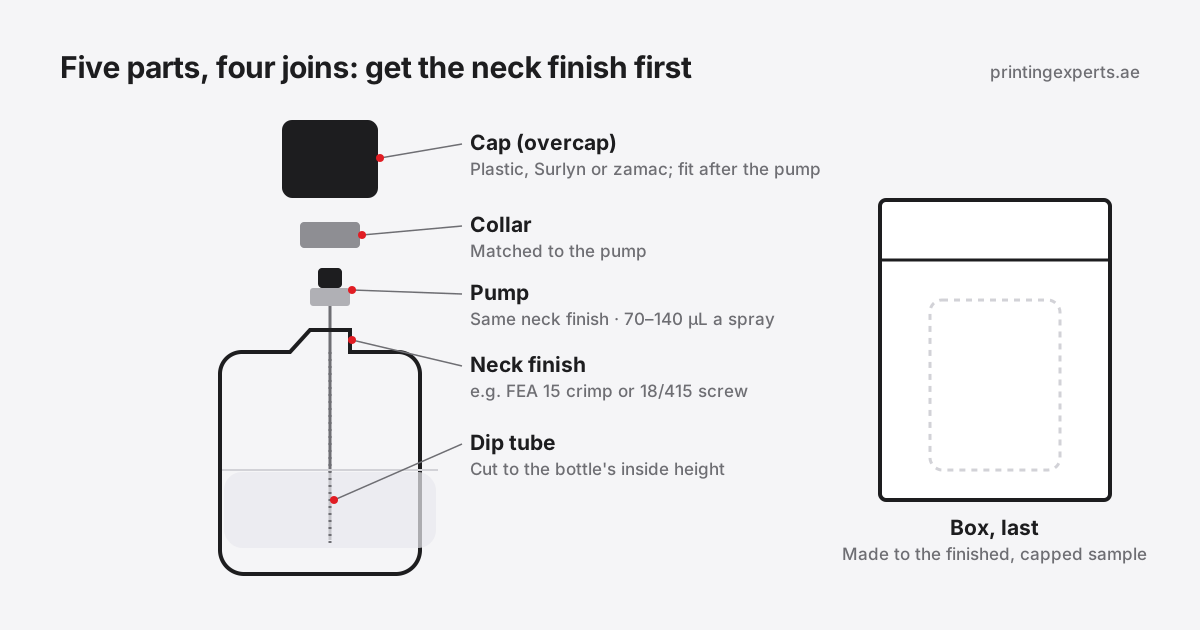
The UAE has suppliers for every part of the pack, from Sharjah traders selling stock bottles with pumps to a Ras Al Khaimah glassworks and Dubai box makers. The difficulty for a new brand isn't finding suppliers. It's making sure the parts it buys from them work together.
The five parts of a perfume pack
| Part | What to specify | What goes wrong |
|---|---|---|
| Bottle | Capacity, shape, glass grade (flint, extra-flint or coloured) and neck finish | Neck finish that no available pump fits |
| Pump (sprayer) | Neck finish, dose per spray, dip tube length, gasket material | Leaks, a dip tube too short to empty the bottle, a gasket that swells |
| Collar | Finish and colour; matched to the pump | Loose or crooked collar after crimping |
| Cap (overcap) | Material (plastic, Surlyn, zamac weight), inside diameter and height | Cap that won't sit over the pump, or rattles |
| Box | Type (folding carton or rigid), insert, finishes | Box made before the final bottle and cap existed |
Neck finish: the measurement that decides everything
The neck finish is the shape and size of the bottle's opening. A pump only fits the finish it was made for, so get the bottle's finish code in writing before you buy pumps.
Crimp necks (FEA)
Most fine-fragrance bottles use a crimp neck. FEA finishes are the European glass neck dimensions set out in EN 14854, in nominal sizes around 13, 15, 18 and 20 mm. FEA 15 is the most common. The pump's metal ferrule is crimped (squeezed) onto the neck with a crimping tool or machine, which makes a clean, premium join that can't be unscrewed. You need crimping equipment, or a filler who has it, and someone checking that every crimp seals.
Screw necks
Screw-neck codes like 18/415 or 20/410 give two things: the thread diameter in millimetres (18), and the thread style (415 is a taller neck with about two turns, 410 about one and a half). The pump screws on by hand, so no crimper is needed, which suits small batches and samples. The join is more visible, and a screw neck doesn't make a bottle refillable by itself.
Two bottles with the same nominal size can still differ in thread profile or neck height. Ask for the technical drawing and send it to the pump supplier. Don't rely on the size alone.
Pumps, dip tubes and caps
- Dose: fine-fragrance pumps typically deliver about 70 to 140 µL per spray (0.07 to 0.14 ml). Check the dose against your concentration and the bottle size; a larger dose empties a 30 ml bottle quickly.
- Dip tube: it's cut to the inside height of the bottle, measured from the gasket to the tip. Too short and the last few millilitres can't be sprayed; too long and it curls. Give the pump supplier a filled sample bottle or the drawing, not just the capacity.
- Cap: the overcap is mostly decorative. The seal is made by the bottle, gasket and pump. A heavy cap can be Surlyn, or plastic with a zamac (zinc alloy) insert for weight. Get the cap after the pump, and test it on a crimped sample: a cap can fit beautifully while the pump underneath is wrong.
Test the whole pack with your fragrance
Alcohol and fragrance oils attack some plastics, gaskets and decorations. Before a big order, put your actual fragrance in a complete, decorated sample pack and check it over time for leaks, weight loss, gasket swelling, a sticky pump, and any change in the colour of the liquid or the decoration. Pump makers such as Aptar run gasket-swell and compatibility tests in their own labs, and the Cosmetics Europe stability guideline asks brands to test in the final pack. The UAE's cosmetics scheme also requires that containers don't interact with the product.
The decoration needs the same test. A logo that survives water can soften or rub off when perfume runs down the bottle. If you print directly on the glass, ask how the ink is made alcohol-resistant and test it with your formula; Sun Studio explains its approach in alcohol-resistant perfume bottle printing.
Stock bottle or custom mould?
A stock bottle is a shape the glassmaker already produces. You can buy relatively small quantities and change suppliers easily, but your competitors can buy the same shape. A custom mould gives you your own shape, at the cost of tooling, development time and a far higher minimum order. Glassmakers don't publish standard minimums, so ask each for its quantity breaks. Most new brands start with a stock bottle and make it their own with decoration, cap and box.
Glass grade matters too. Standard flint glass has a faint green tint from iron. Extra-flint (super flint) uses purer raw materials for a whiter, clearer bottle, which shows a coloured fragrance better.
Decoration: choose by run size
| Method | Best for | Trade-offs |
|---|---|---|
| Direct UV printing | Samples, launches, short runs, personalised bottles, full-colour artwork | No screens, so no set-up per design; test durability with your fragrance |
| Screen printing (organic or fired ceramic ink) | Long runs of one design in a few colours | A screen per colour; fired ceramic is very durable but needs a kiln and more time |
| Hot foil stamping | Metallic logos and lettering | Needs a die; best on flat or simple curves |
| Spray coating and metallisation | Colouring or frosting the whole bottle, mirror finishes | Done by specialist decorators in batches |
| Labels | Many SKUs, regulatory text, low unit cost at volume | Less premium on glass; edges can lift |
For samples and short runs, direct UV printing makes most sense. Sun Studio's perfume bottle printing in Al Quoz prints straight onto flat and round bottles, clear, frosted or coloured, with no minimum order and one sample first. That suits a launch batch, gift editions or bottles with a different name on each. For tens of thousands of one design, compare it with screen printing or labels on price per bottle. Our guide label, sleeve or direct print? covers that decision.
The box: last, but not an afterthought
Perfume usually goes in a folding carton (printed paperboard, folded flat for shipping) or a rigid box (thick chipboard wrapped in printed paper, often with a magnetic lid or drawer). A rigid box costs considerably more and takes longer to make, but it's what most luxury fragrances use. Inserts hold the bottle still, made from paperboard, moulded pulp or foam.
Order the box only once you have a finished sample bottle with its pump and cap, and send that sample to the box maker. Measurements from a drawing miss the cap height and the collar's width. In the UAE, Emirates Printing Press makes folding cartons and rigid boxes for perfume brands, and Shabouk Printing & Packaging focuses on luxury rigid boxes and paper bags for perfume and oud. See our guide to getting boxes made for what to send.
Shipping samples: perfume is dangerous goods
Alcohol-based perfume is flammable, and in transport it's classed as UN1266, "perfumery products", Class 3. Air shipments have to follow IATA's dangerous goods rules, so a courier may refuse a filled sample sent as an ordinary parcel. Send empty components to suppliers where you can, ask your courier for its dangerous goods service, and keep the fragrance's Safety Data Sheet to hand: Section 14 gives its transport class.
Selling it in the UAE
Perfumes are controlled under the UAE scheme for cosmetics and personal care products (Cabinet Resolution No. 18 of 2014), run by the Ministry of Industry and Advanced Technology (MoIAT). In outline, a product needs a conformity certificate under UAE.S GSO 1943, the cosmetics safety standard, which also covers labelling, and then registration with the municipality of the emirate where it's sold: in Dubai, through the Montaji system. Only a UAE company can register a product. Ask your filler or a registration consultant to confirm the current label text, including Arabic and allergen requirements, before you print boxes: reprinting 5,000 cartons costs far more than checking first.
Spec sheet to send every supplier
- Bottle
- Capacity, supplier and code, neck finish (e.g. FEA 15 or 18/415), glass grade, technical drawing
- Pump and collar
- Same neck finish, dose (µL), dip tube length or filled sample bottle, collar finish and colour
- Cap
- Material, weight, finish; test-fit on a crimped sample
- Decoration
- Method, artwork (vector), colours, position; quantity per design
- Box
- Type, insert, finishes; made to the finished sample with pump and cap
- Tests
- Compatibility with your fragrance, leak check, decoration rub test with the liquid
- Quantities
- Launch quantity and expected reorder, so suppliers quote the right price breaks
Questions buyers ask
Crimp or screw pump for a new brand?
Crimp looks more premium and is the norm for fine fragrance, but needs crimping equipment. Screw pumps suit samples, small batches and brands filling by hand.
Can I buy bottles, pumps and caps from one supplier?
Many traders sell stock bottles with matching pumps, collars and caps as a set, which removes most fit problems. Ask for a full assembled sample before ordering.
What about attar bottles?
Attar and perfume-oil bottles are usually small (around 3 to 12 ml) with a roller ball or a glass rod applicator instead of a pump. Thick oils can clog a roller ball, so test with your oil.
When should I order the box?
After the bottle, pump and cap are final and tested. It's the part most often remade because it was ordered too early.
Sources
- Berlin Packaging: neck finish guide
- Aptar: Essencia fragrance pump (dose options)
- Aptar: laboratory compatibility testing
- Cosmetics Europe: guidelines on stability testing of cosmetics
- TricorBraun: how to measure dip tube length
- Intertek: UAE GSO 1943 for cosmetics
- Dubai Municipality: consumer products guideline (Montaji)